SFX runs two production facilities, one in Portland, Maine, and one in Nashville, Tennessee, producing critical documents for credit unions, insurance carriers, and utility companies. Much of that work is transactional mail such as statements and checks. Across both sites, SFX processes close to 5 million mail pieces a month spread across roughly 10,000 individual jobs, a mix that includes a large share of small, low-complexity work.
William Jefferies, Senior Director of Operations, joined SFX about 14 months ago and inherited a floor built around six BlueCrest MSE inserters and five Rival systems. When he dug into the job data, one number stood out. Spreading 5 million mail pieces across 10,000 jobs meant a large share of those runs were small, and small jobs were where the floor was losing the most time.
Running a high volume of small jobs on machines designed for speed created friction that was hard to see until someone on the team looked closely at the numbers. Every job change meant slowing a production machine down for a new setup, then bringing it back up to speed only to repeat the process a few minutes later.

The team monitored the time material waited to be moved from the print workcell to the insert workcell, which added up to hours of wasted time by the end of the week. Getting a job from print to mail meant sign-offs, paper carts, and moving materials, all before the job could run. SFX wanted to increase efficiency by removing those touchpoints and eliminating the sign-off process, with the job coming directly off the printer onto the inserter.
The timing mattered too. SFX has grown mail volume by about 20 percent over the past 15 months and averages close to 4 to 5 million mail pieces a month today between both sites. With open enrollment onboarding underway with several of their customers, they expect an additional 800,000 to 900,000 pieces of mail a month, with peak months during fall open enrollment climbing above 6 million.
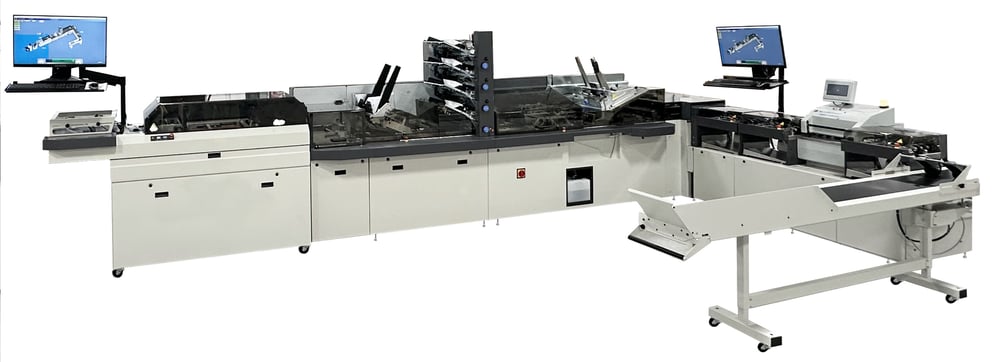
SFX first saw the Element at an industry event in early 2025. Jefferies was initially more interested in the Print+ Statement itself, the component that lets a printer feed directly onto an inserter. At Printing United in Florida later that year, he watched an Element run in the booth for hours, working through the numbers on how the Element and Print+ Statement could benefit the overall operation.
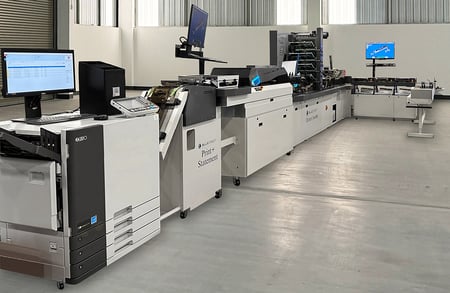
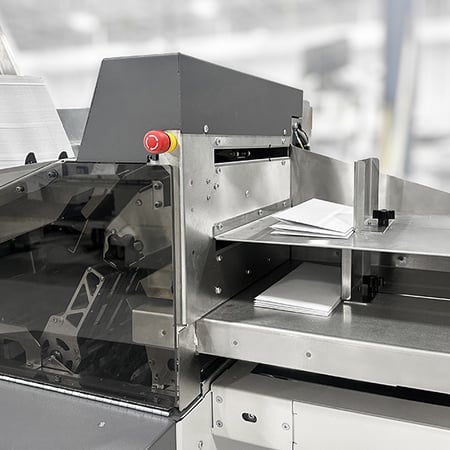
The Element has been running at SFX since mid-June, and the results showed up almost immediately. Within the first week, operators were processing 15 to 18 audit sheets and 3,000 to 4,000 envelopes a day, a pace that outran what the team expected to see so early in the ramp-up.
Early results included:
The time savings came from eliminating a dedicated print workcell and folding printing directly into the inserting process.
SFX has worked with BlueCrest for more than 15 years, a relationship that has grown alongside the company's own production needs. Jefferies pointed to the experience of working with the BlueCrest team throughout the Element installation as a continuation of that history.
For SFX, the decision to bring on the Element builds on a track record with BlueCrest equipment already running across its Rival and MSE fleet, and a service relationship the company has relied on for over a decade and a half.
As the Element ramps up to full capacity, SFX plans to explore how much further the platform can go, including testing additional job types beyond envelopes to see where else the Print+ Statement concept applies.
Looking further out, SFX sees its investment in the Element as a signal for how future equipment decisions get made, including whether to upgrade its older systems or invest in newer technology with more advanced automation, across both its Maine and Tennessee operations. With peak volumes expected to climb above 6 million pieces a month, SFX is looking to BlueCrest not just as an equipment vendor but as a partner in planning that growth — evaluating additional Elements, exploring further Print+ Statement use cases, and leaning on BlueCrest's service team as the floor scales across both facilities."
SFX's experience with the Element and Print+ Statement shows how consolidating small-job printing and inserting into a single workcell can free up capacity and increase efficiency across an entire production floor, not just on one machine. It's a shift SFX plans to build on as it continues to grow across two facilities and more than 15 years of partnership with BlueCrest.
About SFX
SFX is a print and mail service provider operating facilities in Portland, Maine, and Nashville, Tennessee. The company provides front-end software along with print and insert production for credit unions, insurance carriers, and utility companies, processing close to 5 million mail pieces a month.
About BlueCrest
BlueCrest is a global provider of mail processing, inserting, software, printing, and automation solutions serving customers across financial services, healthcare, and government sectors. The company's equipment and software support high-volume mailing operations with a focus on reliability, compliance, and operational efficiency. BlueCrest is headquartered in Danbury, Connecticut.





