How Renkim Rebuilt Its Print and Mail Operation Around Roll-to-Roll Production.
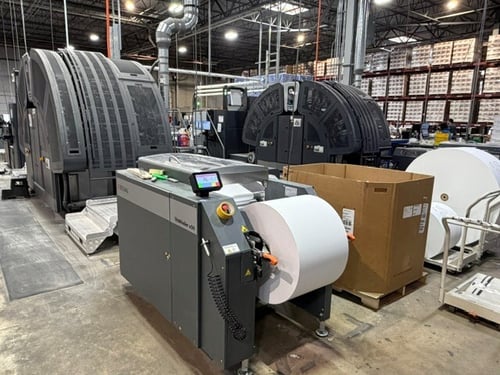 Working with BlueCrest, Renkim Corporation rebuilt its entire production environment around continuous roll-to-roll printing and inserting. The presses supplied the speed. BlueCrest Output Manager supplied the workflow behind it, merging more than 300 daily jobs into fewer than 150 so that the new capacity could be achieved. Two years later, the company is producing more than 40 percent more printed images and mail pieces, with fewer jobs, fewer operators per machine, and reduced overtime.
The platform combines two BlueCrest IntelliJet 20 presses, roll-fed Epic and Rival inserters, and BlueCrest Output Manager software to consolidate job streams and enable file-based processing. Equally important was the work that surrounded the equipment. BlueCrest print, mail, and postal specialists worked alongside the Renkim team to redesign the workflow, establish best practices for roll-fed production, and train operators on the new environment.
Renkim has been in the print and mail business since 1982 and runs an 160-person automated production operation in Southgate, Michigan. Every share of the company belongs to the people who work there, and that structure shapes how capital decisions get made.
When Renkim’s first-generation inkjet equipment neared end of life, the company chose not to replace the presses in kind. Instead, it used the moment to re-engineer the way work moves through the plant, shifting from a cut-sheet environment to continuous roll-to-roll production across both print and inserting.

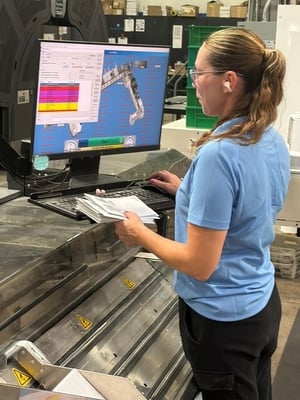 Renkim was running more than 300 separate jobs a day. Each one carried its own setup, its own staging, its own run, and its own handoff to the inserting area. Fifteen to twenty of those applications required specialty pre-printed forms that had to be stocked, inventoried, and ordered separately. Every job change meant a stop, and every stop cost time the company did not have against 24-hour service-level agreements.
Keeping high-speed inserting running efficiently is more physically demanding in a cut-sheet environment. Cutting, loading feeders, and managing the paperwork tied to frequent job setups required multiple people per line.
“Our people are our most important asset,” Lenden said. “We had to make sure we were giving them the best equipment and software to take full advantage of the latest technology available.”
Mail volume was rising, and Renkim needed to create capacity inside its existing operation. The company’s core work spans collection notices, automotive communications, healthcare statements, utility bills, checks, and class action notifications, a mix that produces unscheduled peaks. Absorbing that growth without changing the technology and the processes around it would have meant overtime, weekend shifts, and outsourcing work the company would rather run itself.
Roll-to-roll offered a different path: fewer touches, longer uninterrupted runs, and a direct connection between print and finishing. Getting there required more than new presses. It required software to combine smaller jobs into larger ones, and it required people who understood how print, inserting, and postal requirements fit together.
That combination is what Renkim was buying. BlueCrest brought Output Manager to handle printstream transformation, job consolidation, and post-job reporting, and brought specialists who knew how to apply it against Renkim’s specific job mix.
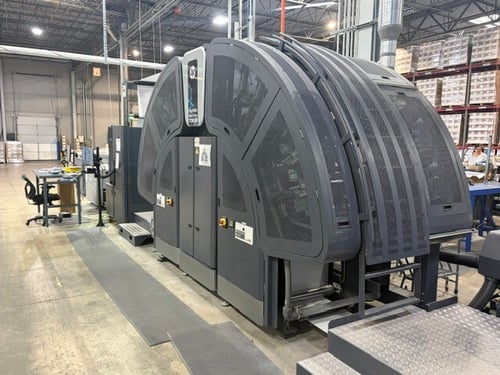 Renkim replaced three aging inkjet systems with two IntelliJet 20 presses, paired with its BlueCrest Epic and Rival inserting fleet. The new presses brought better print quality, lower running costs, and longer runs while increasing overall print capacity.
Output Manager did the consolidation work. Jobs with similar components could be merged into single print files rather than staged and run individually.
“BlueCrest’s expertise in understanding print, insert, and postal requirements helped us cut our jobs down by roughly 70 percent,” Lenden said. “They knew which jobs could be combined and how to build the workflow to do it.” Renkim now runs fewer than 40 optimized workflows where it once ran more than 300 separate jobs.
The clearest change is how many people it takes to run a line. Roll-fed inserting eliminated the need for a two-operator workcell, which freed an operator to work elsewhere across the operation. Overtime tied to SLA pressure has been greatly reduced, and the speed of the presses now absorbs work that used to require extra shifts.
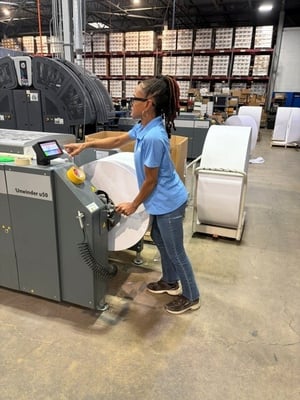
The capacity question stopped being theoretical when the large jobs arrived.
Renkim has been running roughly 13 million mailpieces a month for the past four months, including a single drop of approximately eight million pieces against a tight SLA. Work at that scale can sometimes arrive unannounced.
“You can see huge peaks that would have meant overtime, weekends, and outsourcing,” Lenden said. “The additional capacity in print and mail kept the work in house and let us hold our SLAs through the unexpected peak.”
The added capacity has opened other doors as well. Renkim has taken on disaster recovery work for utility and mortgage clients who need a partner with matching equipment and available headroom, and that work has brought the company into vertical markets it had not served before.
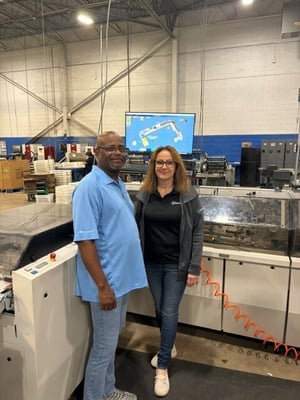
Renkim’s decision to consolidate on a single platform rested heavily on service coverage. Waiting on outside service technicians could previously cost hours of downtime. Renkim now has two cross-trained BlueCrest technicians on site, backed by the training, productivity, and maintenance programs that make up BlueShirt Excellence.
“Downtime on the presses dropped substantially,” Lenden said. “Problems get addressed quickly, they keep us on our preventive maintenance schedule, and we use BlueCrest’s Operational Planner software to run modular PMs on the inserters.”
The result translate to better uptime and production numbers. “For the number of people we have,” Lenden said, “our mail pieces per belt and high efficiency are as strong as anyone’s on the east side of the Mississippi.”
“Our customers want flexibility for their customers,” Lenden said. “Paper, text, and e-statement. That package, plus being an ESOP company that takes customer service seriously, is our edge.”
On the production side, the platform is set. Between the presses, the roll-fed inserting environment, and the software connecting them, Renkim expects this configuration to carry the operation for the next seven to ten years. Other operations are watching, and Renkim has been happy to host mailers looking to transform their own environments the same way.
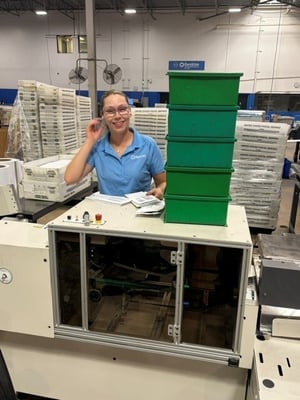
Renkim’s transformation offers a useful reference point for any operation weighing whether to scale a cut-sheet environment or rebuild around continuous production. The gains did not come from a single machine. They came from consolidating job streams in BlueCrest’s Output Manager software, connecting print directly to finishing, converting specialty forms to white paper, and putting service coverage close enough to the floor to protect uptime.
Working with BlueCrest gave Renkim more than software and presses. It gave them print, mail, and postal specialists who knew how to apply that technology against a specific set of operational problems. Renkim is now doing significantly more work with the same team, holding tight SLAs through unpredictable peaks, and taking on business it could not have accepted two years ago.
ABOUT RENKIM
Founded in 1982 and headquartered in Southgate, Michigan, Renkim Corporation is a 100% employee-owned consumer communications company specializing in print, mail, email, and text solutions. With client-partners in the ARM industry, healthcare, utility, marketing, financial, automotive, and government sectors, Renkim’s team of employee-shareholders delivers secure, accurate, and timely communications across regulated industries. For more information, please visit www.renkim.com.
ABOUT BLUECREST
BlueCrest is a global provider of mail processing, inserting, software, printing, and automation solutions serving customers across financial services, healthcare, and government sectors. The company’s equipment and software support high-volume mailing operations with a focus on reliability, compliance, and operational efficiency. BlueCrest is headquartered in Danbury, Connecticut. For more information, please visit www.bluecrestinc.com.





