





For most inserting and mailing operations, the move from sheet feed to roll feed is not a matter of if but when. It is a natural progression as volumes grow, service level agreements tighten, and the labor market stays as tough as it has been. What tends to hold operations back is not the case for the move. It is the difficulty of knowing, with any confidence, whether the numbers work for their specific floor.
This article is meant to help with that decision. It walks through the operational signals that suggest a floor is ready, the improvements roll production typically delivers, the situations where roll is less of an obvious win, and a straightforward path for building a capital justification from your own data.
Why Would I Consider This Move?
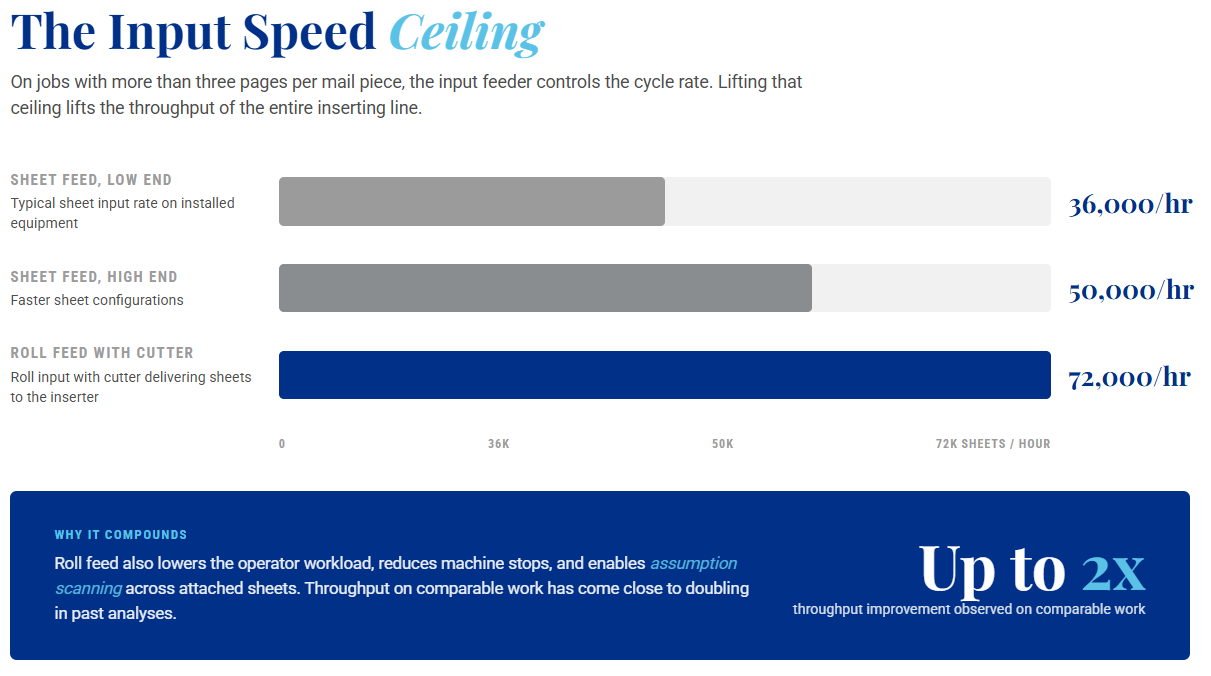
Roll feed changes the economics of an inserting operation in a few places at once. Input speed goes up, operator workload comes down, and the number of things that can interrupt a run drops noticeably. Sheet input on a typical inserter delivers 36,000 to 50,000 sheets per hour. Roll input cutters can push 72,000 per hour. For any job with more than three pages per mail piece, the input side is the constraint, and lifting that ceiling lifts everything else with it.
The productivity gain is not just about raw speed. Roll production is less labor intensive at the inserter, which lets an operator focus on running the machine rather than feeding it. The input sheets on a roll come attached to one another, which enables assumption scanning: if the number of missed barcode scans equals the number of pages that were not scanned, the system can safely assume integrity. Sheet-fed production cannot make that assumption. Cutters also produce fewer alarms than sheet feeders, which means fewer machine stops, fewer operator interventions, and fewer opportunities for outsorts.
Across engagements, throughput gains from moving to roll production have often come close to doubling on comparable work.
What Signs Show My Floor is Ready?
The clearest signals that a floor could benefit from moving to roll production tend to be operational rather than financial. If several of the following are true on your floor, the conversation is worth having because roll production can solve problems.
- Work in process is stacking up. Multiple stacks of paper sit around the shop waiting for time on an inserter.
- You upgraded your print cell but have not turned on the rewind capability.
- Overtime hours are climbing to keep SLAs on track, cover open positions, or absorb employees on leave.
- Jobs get moved on and off inserters throughout the shift to juggle SLA requirements.
- Large jobs get split into smaller ones to spread the work across multiple inserters.
None of these individually mean the move is required. Taken together, they usually mean the current workflow is running into limits the operation has already started paying for in overtime and complexity.
What Are Some Improvements I Can Expect?
Roll production tends to deliver in three areas.
1. Throughput. With the input constraint lifted and the operator freed from feeding sheets, jobs move through the floor faster. On input-bound work, which is most jobs with more than three pages per mail piece, the improvement can be dramatic.
2. Outsort and reject reduction. Fewer alarms and fewer outsorts mean fewer reprints, and reprints are expensive. A reprinted piece can cost up to ten times the original production cost once setup, materials, and lost sorting capability are factored in. Reducing reprints even modestly is often where a meaningful share of the savings comes from.
3. Fewer machine stops. Every stop pulls an operator over to clear it, and every stop carries a risk of additional outsorts as integrity rules kick in during recovery. A floor that stops less, runs more, with less operator overhead per production unit.
When is it NOT the Right Answer?
Roll production is not the right answer for every job, and being clear about that up front tends to strengthen rather than weaken the case for the move.
The most common concern is job size. If the work available for roll production is not large enough to fill full rolls, multiple jobs can share a roll, which introduces blank pages between them. Those blanks have to be removed at the inserter rather than at the printer, which is a different operational rhythm than a sheet environment. In practice, the total number of blank sheets is often not higher than in sheet production, but the removal happens further downstream. Some of this can be managed by keeping the printer queued with ready work so that the transition between jobs on a roll uses only a few blank pages.
The second concern is expediting. If a job sits inside a roll with other jobs wrapped around it, the outer jobs run first. That is a real trade-off, and it comes up in any operation that occasionally needs to jump a rush job to the front.
Both situations are worth acknowledging in the planning phase and worth weighing against the throughput, outsort, and stability gains on the majority of the work. In most operations, the trade-off leans clearly toward roll.
Help Me Justify it with My Own Data
 The case for moving to roll production is strongest when it is built on the production data from your floor, not on industry averages. The following data set is usually enough to build a defensible capital justification.
Twelve months of job data covering:
- Number of jobs
- Number of mail pieces per job
- Total pages per job
- Number of shifts per day
- Log-in hours, by day where possible
- Number of hours worked per operator per day
- Overtime hours per week
If your operation is already running BlueCrest equipment with DC, like the Epic or the Evolution inserting solutions, this data lives on each machine or on the network in two files: proddata.txt and alarmdet.txt. Pulling those files is often the fastest way to get to a real baseline.
From there, the analysis follows four steps.
- Establish the current-state baseline. Calculate current throughput in pieces and sheets per hour from the existing data. This is what any projected improvement will be measured against.
- Sort the work by suitability. Not every job will be a candidate for roll production. Identify what runs today, and answer three questions about each category: Can jobs be combined to run together on a roll? Can multiple jobs share a roll? Where is the cutoff for running roll versus cutsheet?
- Project the future-state throughput. Apply roll-production improvement factors to the suitable work and model the resulting reductions in operator hours, overtime, and equipment needed.
- Decide how to redeploy the savings. The efficiencies can go to more business, less overtime and better work-family balance for staff, or future investment. The strategic conversation is easier once the numbers are on the table.
A Final Note on Timing
Operations that wait to make this move often end up making it under pressure, when a large new client comes on, an SLA gets tighter, or a labor gap forces a decision. Doing the analysis before that pressure hits tends to produce a better decision and a smoother transition. The data required is not exotic. Most of it is already sitting on the equipment or in the shop.
If you can put twelve months of production data on a table, you can put a real number on what the move would mean for your floor.
Share article


Justin O'Donnell

0 comments