





A call with a recent client struck a chord with us. They said:
"You don't get a lot of efficiency when you're stopping every seven minutes to go to another job."
The client spoke to a fact that most production floors are designed and measured around their biggest numbers. Pieces per hour. Envelopes per shift. Machine speed at full tilt. Those are the figures often shown on equipment brochures and capacity planning spreadsheets, and for good reason. They tell you what a machine can do when it is running the job it was designed for.
They do not tell you much about what happens between jobs.
If you run a print and mail services operation of any real size, chances are your job list looks less like a handful of massive runs and more like a long tail of small ones. A facility processing a few million pieces a month might be spreading that volume across thousands of individual jobs, many of them small enough that the machine barely gets up to speed before it is time to slow down again. Individually, none of those jobs look like a problem. Added together across a week, they can quietly account for a surprising share of lost production time.
Why Small Jobs are Hard on High-Speed Equipment
High-speed inserting and print equipment is built for sustained runs. The economics of the machine, and the labor and floor space that support it, assume long stretches of consistent output. A large job lets that equipment do what it does best.
A small job demands it to do something closer to the opposite. Ramp up, run for a few minutes, ramp down, then reset for the next job. Every changeover carries a fixed cost in time, regardless of how small the job is. Run enough small jobs back to back and that fixed cost starts to dominate the schedule, even though the equipment itself never stops being fast.
This is easy to miss because the machine still looks productive. It is running, it is fast, and the operator is busy. What is harder to see, without looking closely at the data, is how much of that busyness is changeover rather than output.
The Costs that Hide Behind the Throughput Numbers
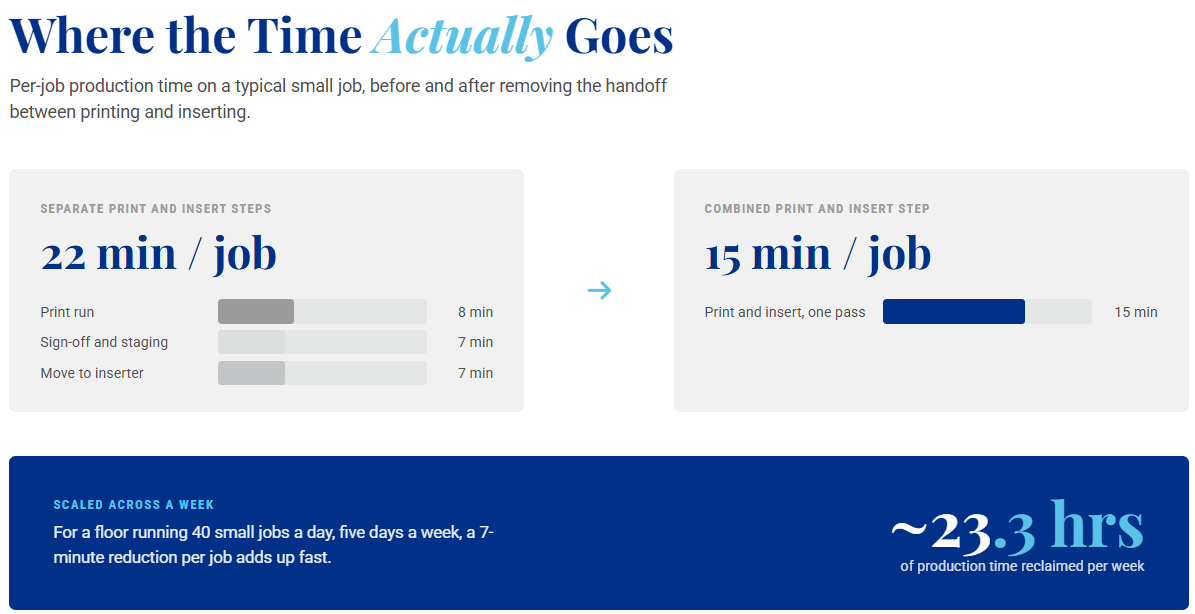
Speed at the machine is only part of the picture. Between printing and inserting, most mail production operations have a series of steps that exist to keep jobs accurate: a sign-off before a job is released to run, a physical move of paper or files from one workcell to another, a staging period while the next job gets set up.
Each of those steps makes sense on its own. Sign-offs catch errors before they become mailed errors. Staging keeps jobs organized. But each step is also a point where a job sits and waits rather than moves forward, and on a floor running thousands of small jobs a month, those waiting periods add up in a way that is easy to underestimate until someone tracks it.
The pattern tends to show up the same way in operation after operation. A team assumes the constraint is machine speed, then looks at the data and finds the real constraint is the space between machines and the steps required to get a job from one workcell to the next.
The Stories your Job Data Can Tell You
The most useful diagnostic here is often the simplest one: pull the actual job list, not the summary volume number, and look at the distribution. How many jobs are small enough that changeover time rivals or exceeds run time? How much of a typical week is spent on setup and handoffs rather than production?
For many operations, this exercise reframes the problem. The question stops being how much faster can this machine go and becomes how many steps can be removed between the jobs already moving through the floor. Those are different problems with different solutions, and conflating them tends to lead operations toward equipment upgrades that do not actually address where the time is going.
Consolidate Strategically
One response to this pattern is architectural rather than incremental: instead of speeding up each individual step, remove the gap between steps entirely. Printing and inserting handled as a single connected process, rather than two separate workcells linked by a manual handoff, eliminates the staging and movement time that a fast machine cannot make up for on its own.
This kind of consolidation tends to work best for exactly the volume profile described above: high job counts, modest page counts per job, and a floor where changeover and handoff time make up a meaningful share of the week. In that environment, removing a step often does more for total throughput than adding speed to any individual machine, because the constraint was never really about speed in the first place.
There is also a cascade effect to consider. When small jobs move through a leaner, more self-contained process, the higher-speed equipment on the floor is freed to spend more of its time on the large, sustained runs it was designed for. Capacity is gained in two places at once: less friction on the small jobs, and more available time on the big ones.
The Takeaway
None of this is really about any one piece of equipment. It is about where operational time goes on a busy production floor, and how easy it is to mistake motion for progress when a machine is running fast but a job is still slow to complete.
Any operation processing high volumes across a large number of small jobs is worth a closer look at its own data before assuming the next investment should be about speed. Sometimes the biggest efficiency gain available is not a faster machine. It is one less step between the jobs you already have.
Share article


Justin O'Donnell

0 comments